Top 7 Alternatives of CARESTREAM Vue PACS
Many radiology teams outgrow CARESTREAM Vue PACS when their storage, sharing, and AI needs exceed what the platform supports without extra modules or on-site hardware. Some tools now require separate vendor contracts for each location, while others charge for every DICOM viewer seat.
By the end of this article you will know the seven concrete criteria most teams use to evaluate replacements, see how Medicai stacks up against six other platforms on those criteria, and have a shortlist ready for vendor calls.
What to Look For in CARESTREAM Vue PACS Alternatives
Evaluating alternatives to CARESTREAM Vue PACS starts with defining the must-have capabilities that ensure compliance, performance, and long-term scalability.
Organizations should begin by confirming HIPAA and GDPR compliance across every system component. These regulations protect patient data during storage, transmission, and access. Without clear compliance documentation, even advanced features lose value.
Next comes verification of IHE profiles that support standardized data exchange between departments and external partners. Profiles such as XDS-I and WIA establish consistent workflows for image sharing and retrieval across institutions.
The zero-footprint DICOM viewer determines how quickly clinicians can access studies without local installation. Browser-based access reduces IT overhead while supporting remote consultations and emergency reviews from any connected device.
HL7 integration depth affects how smoothly imaging data flows into electronic health records. Deep integration allows automatic order updates, result notifications, and patient demographic synchronization without manual entry.
Storage requirements vary by facility size. Systems should scale from 500 GB for smaller practices to 2 TB or more for hospitals handling high imaging volumes. Expandable archives prevent future migration costs.
Annual API transaction capacity above 50 million supports growing data exchange needs. High-volume environments depend on reliable API performance for automated routing, teleradiology transfers, and third-party application connections.
Finally, confirm teleradiology platform support for secure image sharing across locations. This capability becomes essential when radiologists work remotely or when multiple sites require centralized interpretation services.
1. Medicai - Best Overall
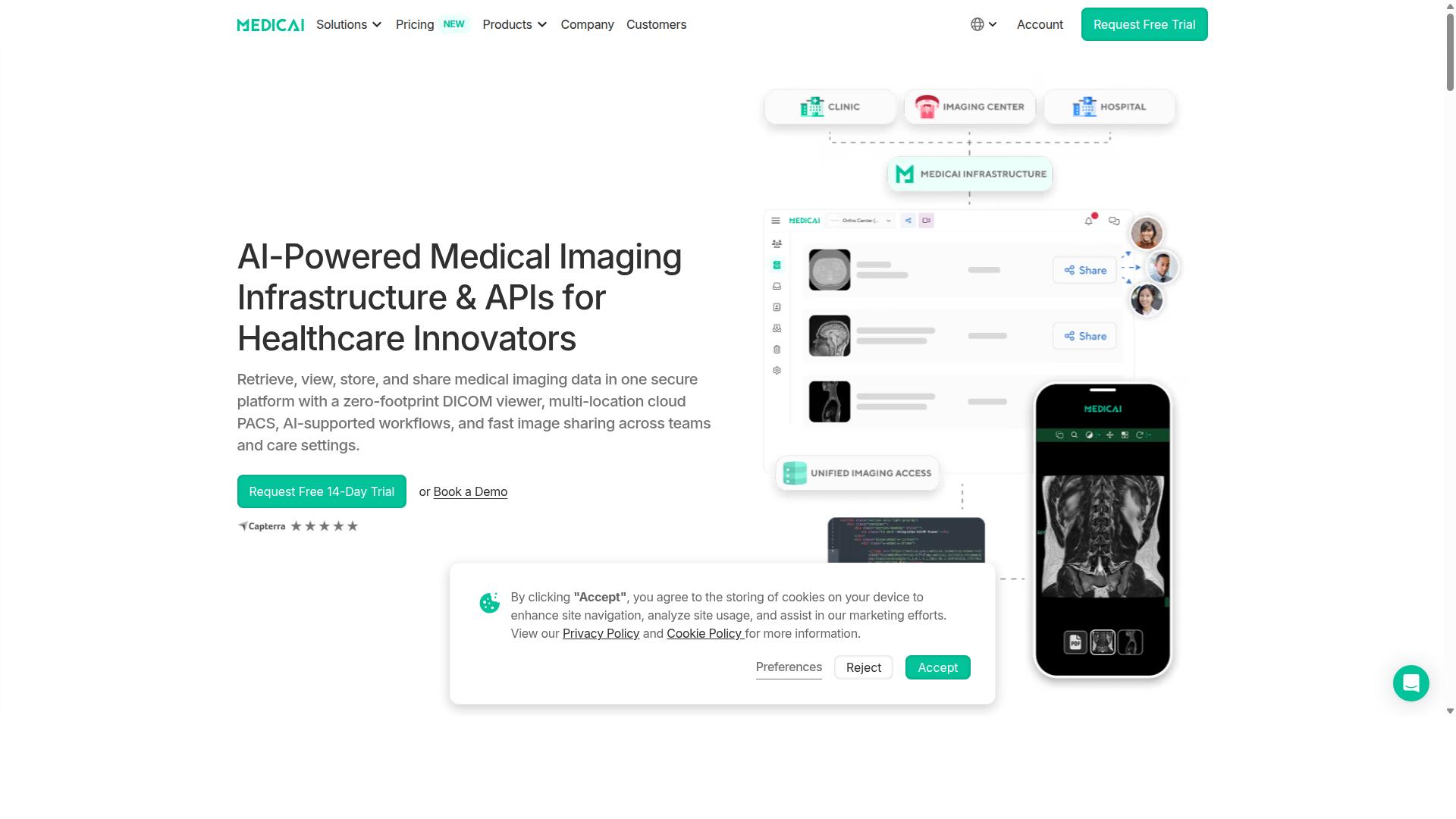
Medicai stands out as the best overall alternative due to its comprehensive cloud architecture and zero-footprint viewer that eliminates local installation requirements.
Healthcare facilities seeking CARESTREAM Vue PACS replacements often need systems that support multi-location access without hardware investment. Medicai delivers this through its Imaging Infrastructure as a Service model.
Organizations gain centralized access to imaging data across care settings. Teams can retrieve, view, store, and share medical imaging data without managing on-premise servers.
The platform integrates with existing radiology workflows. Providers maintain HIPAA compliance while enabling secure image exchange between departments and external partners.
Medicai Key Features
Medicai's key features center on its zero-footprint DICOM viewer and multi-modality capabilities.
The Medical Imaging Uploader and DICOM Gateway simplify image import from various modalities. These tools connect directly to existing equipment without additional middleware.
Cloud PACS and Vendor Neutral Archive capabilities provide scalable storage solutions. Organizations manage imaging data through a single, secure repository that supports multiple locations.
The platform processes 1M+ studies annually and maintains 1.7M+ studies in storage. Healthcare teams access 50M+ yearly API transactions for seamless system integration.
AI-supported workflows assist with study routing and case management. Provider teams collaborate through structured reporting tools and dedicated imaging portals for doctors and patients.
Medicai Pricing
Medicai's pricing structure offers two monthly billing tiers that scale storage and connectivity based on organizational needs.
The Starter plan costs $249/month and includes 500 GB Cloud Storage with unlimited user accounts. This tier suits smaller practices or departments beginning their cloud migration.
The Standard plan costs $749/month and provides 2 TB Cloud Storage, unlimited user accounts, and one connected location. This option supports growing organizations requiring additional storage capacity.
Enterprise customers access custom pricing for multiple connected locations and external connections. DICOM Gateway setup requires a $1,000 one-time fee per location.
Yearly billing provides 15% savings. The Starter plan becomes $209/month and Standard becomes $639/month when paid annually. Organizations receive a 14-day trial of Starter plan features without requiring credit card information.
2. Studycast
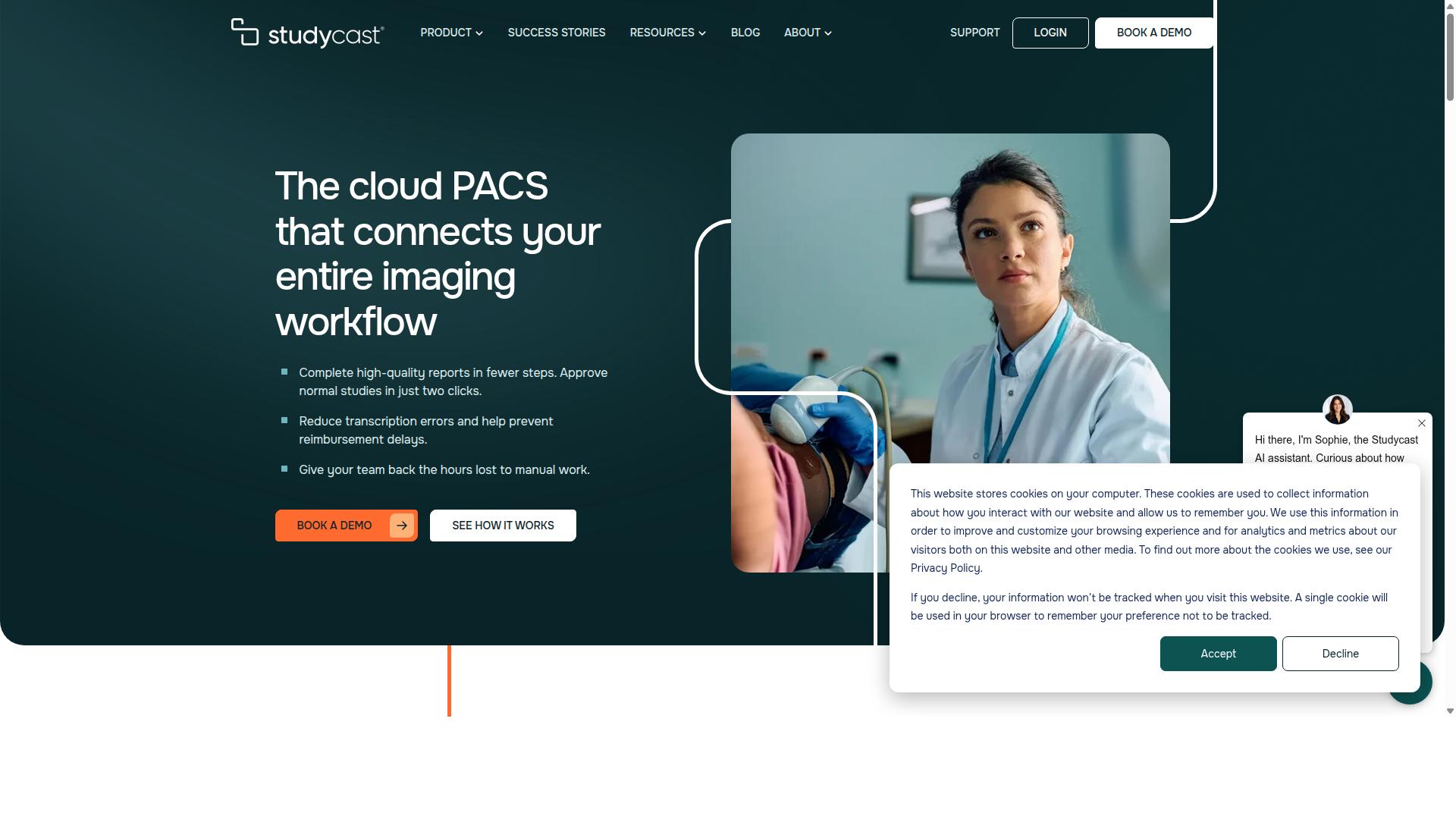
Studycast provides a cloud-based PACS solution with a focus on cardiology and vascular imaging workflows. The platform stores, reviews, and reports studies from ultrasound, nuclear imaging, X-ray, and MRI modalities. Organizations can access studies from private practices, hospitals, and mobile imaging services through a unified interface.
Cloud storage keeps imaging data accessible without on-premise hardware requirements. Users share studies through HIPAA-compliant channels with external physicians or referral networks. The system integrates with existing EHR platforms to streamline data exchange.
DICOM viewing tools support multi-modality display with structured reporting templates. Physicians can approve normal reports in two clicks, reducing time spent on routine cases. The average exam read-and-approve cycle takes 2.4 minutes according to vendor data.
Cardiology-specific reporting features include 140-plus study types tailored to heart and vascular examinations. Structured templates guide users through required measurements and findings. Workflow automation routes studies to appropriate readers based on specialty and availability.
The platform serves sonographers, administrators, and IT staff in office-based labs, ambulatory surgery centers, and academic research settings. Image sharing capabilities extend to veterinary practices and women's health clinics. Customer satisfaction exceeds 95 percent across implemented sites.
3. Intelerad
Intelerad delivers enterprise-grade PACS solutions with emphasis on large health system deployments and workflow orchestration. Their platform supports secure image exchange across healthcare networks. Enterprise imaging capabilities extend to radiology, cardiology, pathology, and point-of-care departments.
The system handles DICOM workloads efficiently while integrating with vendor neutral archives. Hospitals use this platform to unify imaging records from multiple facilities. Workflow orchestration tools help manage complex routing and study distribution patterns across large networks.
Intelerad's diagnostic workstation provides radiologists with access to studies from various modalities. The platform supports standard interoperability standards including HL7 integration for RIS connectivity. Large health systems deploy these tools when they need to consolidate imaging across multiple locations.
Research suggests that enterprise imaging platforms benefit organizations managing high study volumes. Intelerad focuses on secure sharing capabilities that meet regulatory requirements. The solution addresses needs of hospitals seeking to replace legacy PACS systems like CARESTREAM Vue PACS.
4. ProtonPACS
ProtonPACS focuses on cloud-hosted PACS solutions with emphasis on ease of deployment and managed services.
The system stores and manages images from MRI, CT, x-ray, ultrasound and other modalities through a centralized cloud platform. Healthcare facilities can access these studies from multiple devices without maintaining local servers.
Advanced workstations include AI tools, 3D reconstruction, automated measurements and worklist automation. These features help radiologists handle daily case volumes with consistent turnaround times.
Real-time updates and multi-device accessibility support flexible workflows across different locations. Staff members can review studies and generate reports from various workstations or mobile devices.
HIPAA-compliant security protects patient data throughout storage and transmission. The platform integrates with existing RIS and EMR systems to maintain current clinical workflows.
Facilities seeking simplified deployment often consider ProtonPACS when evaluating PACS alternatives. The managed service model reduces the need for in-house IT resources while maintaining diagnostic imaging capabilities.
5. Ambra Health
Ambra Health specializes in cloud-based medical imaging exchange and sharing platforms for multi-institutional collaboration. The platform focuses on secure storage, upload, and exchange of both DICOM and non-DICOM images across different healthcare organizations and EHR systems.
Image sharing capabilities allow healthcare providers to transfer medical studies between institutions without physical media. Role-based access controls ensure only authorized personnel can view or manage specific patient data while maintaining compliance standards.
Cloud platform features include web-based diagnostic viewing tools with annotations and measurements. Users can also anonymize data for research purposes and collaborate remotely on complex cases across geographic locations.
Multi-institutional workflows benefit from the vendor neutral archive approach that supports various medical specialties. This includes radiology practices, hospitals, health systems, cardiology departments, and academic research organizations that need consistent image access across multiple sites.
6. UltraLinq
UltraLinq provides cloud-based ultrasound PACS solutions with emphasis on point-of-care imaging workflows. This platform delivers secure remote access to patient reports and images from any internet-connected device. Healthcare facilities can maintain diagnostic quality while supporting flexible work arrangements.
Ultrasound-specific capabilities form the core of this solution. Cardiologists, sonographers, and vascular specialists use mapped reports and 3-click customizable worksheets for consistent documentation. Post-processing analytics help refine measurements and calculations during review.
Cloud deployment means organizations avoid local server maintenance. Enterprise security features include multi-factor authentication and single sign-on integration. Users can switch between light and dark interface modes based on their preferences and lighting conditions.
Point-of-care imaging support extends to rural clinics, family practices, and women's health centers. The platform serves 8,000 locations and 70,000 users across multiple specialties. Educational institutions and research facilities also rely on the system for training and data management.
Usage-based pricing starts at $3999 one-time according to Capterra listings. Transparent pricing models eliminate hidden fees or minimum volume requirements. Organizations can scale access based on actual imaging volume without long-term commitments.
7. Agfa HealthCare
Agfa HealthCare offers both on-premise and cloud PACS solutions with comprehensive enterprise imaging capabilities. Large medical facilities often need systems that handle multiple specialties while maintaining strict security standards. Their approach combines several imaging systems into one unified platform.
The Enterprise Imaging platform merges PACS, VNA, and clinical imaging tools into a single secure system. This platform supports radiology, cardiology, digital pathology, breast imaging, and other specialty areas. Medical facilities can deploy it on-premises, in hybrid setups, or entirely in the cloud.
Key components include XERO Universal Viewer, RUBEE AI, RUBEE Orchestrator, and a complete Vendor Neutral Archive. The platform also provides Business Intelligence tools and Enterprise Imaging Scheduling features. These elements work together to create streamlined workflows for medical staff.
Security forms a core part of the system design rather than an add-on feature. The platform emphasizes interoperability standards and clinician-focused workflows throughout its architecture. This approach helps large facilities maintain consistent data management across departments.
Research suggests that integrated healthcare IT solutions can reduce the complexity of managing separate systems. Large medical facilities often benefit from having one platform handle multiple imaging modalities. The standards-based approach supports existing hospital infrastructure investments.
Medical facilities looking at PACS alternatives should evaluate how well each system handles their specific workflow needs. Enterprise imaging platforms typically offer more flexibility than standalone PACS solutions. The choice often depends on current infrastructure and future expansion plans.
How to Choose the Right Option
Selecting the appropriate PACS alternative requires matching specific organizational requirements to platform capabilities and deployment models.
Hospitals with multiple imaging departments typically need enterprise imaging solutions that support high-volume storage and multi-site access. These facilities often prioritize HL7 integration and RIS integration to connect existing clinical systems.
Imaging centers usually focus on cost-effective storage needs and efficient workflow orchestration. They may prefer cloud PACS solutions that eliminate on-premise hardware maintenance while maintaining HIPAA compliance standards.
Specialty care providers in orthopedics and neurology require diagnostic workstations with advanced measurement tools and 3D reconstruction capabilities. These practices benefit from platforms offering multi-modality viewer support for diverse imaging types.
Oncology and cardiology providers need robust annotation features and hanging protocols for complex case review. Tumor boards working across these specialties often seek vendor neutral archive capabilities that support collaborative image sharing.
Deployment preferences vary significantly across provider types. Some organizations maintain on-premise PACS for complete data control, while others adopt cloud-based approaches for scalability and remote access through zero-footprint viewer technology.
Virtual care providers and telemedicine platforms require teleradiology platform functionality with mobile access capabilities. These organizations need reliable study routing and modality worklist integration to support distributed care models.
Research suggests that matching platform requirements to provider type improves clinical workflow efficiency. Organizations should evaluate their storage volume, integration needs, and deployment preferences before selecting among PACS alternatives.
Final Verdict
The choice among PACS alternatives ultimately depends on organizational size, workflow complexity, and the need for cloud scalability versus on-premise control.
Key differences emerge across deployment models, integration capabilities, and regulatory compliance. Some platforms favor on-premise setups for maximum data control, while others prioritize cloud delivery for remote access and reduced infrastructure costs.
Medicai stands out through its cloud-first architecture with proven scale. The platform processes 1M+ studies yearly, maintains 1.7M+ studies in storage, and handles 50M+ API transactions annually.
Healthcare providers gain access to FDA and CEE cleared viewers with HIPAA and GDPR compliance built into every workflow. These certifications support deployment across multiple regulatory environments without additional configuration.
Interoperability reaches 10,000+ active doctors across 70 clinics and hospitals worldwide. The platform supports 2M+ imaging studies uploaded and enables global multidisciplinary tumor boards through secure image sharing.
Microsoft Azure partnership provides enterprise-grade infrastructure for institutions requiring geographic data residency. Performance metrics show diagnosis time reductions of 65 percent compared to traditional workstation setups.
Organizations evaluating PACS alternatives should assess their specific requirements for regulatory clearance, API capacity, and global accessibility. Medicai addresses these needs through verified scale, compliance certifications, and cloud architecture designed for medical imaging workflows.
Recommended Resources: