IntelePACS vs Medicai: Enterprise Imaging Compared
You are comparing two enterprise imaging platforms and need a straight answer, not a feature dump. Choosing wrong means radiologists fighting a clunky viewer, IT teams managing storage, and budgets stretched by licensing you do not need. Both IntelePACS and Medicai solve medical imaging at scale, but they solve it differently.
This comparison breaks down deployment models, zero-footprint viewing, storage and image exchange, AI workflows, integrations, and compliance. You will see how pricing structures diverge and which platform fits your organization. By the end, you will have a clear verdict on whether Medicai or IntelePACS matches your clinical and operational needs.
Quick Verdict: IntelePACS vs Medicai
If you need a cloud-native, zero-footprint PACS with transparent monthly pricing, Medicai is the clear winner; IntelePACS remains a strong choice for large health systems already invested in on-premise infrastructure.
The two platforms sit at opposite ends of the enterprise imaging spectrum. IntelePACS is a long-established on-premise system built for hospital groups that want to own and control their imaging infrastructure. Medicai is a cloud-native picture archiving and communication system delivered entirely through the browser, with no local servers to maintain.
That architectural split drives nearly every other difference, from how each product is priced to who tends to buy it. Below is a fast side-by-side summary before the deeper comparison.
| Factor | Medicai | IntelePACS |
|---|---|---|
| Deployment model | Cloud-native, zero-footprint viewer | On-premise, enterprise-scale |
| Pricing structure | Transparent monthly pricing starting at $249/month | Custom-quoted, typically project-based |
| Target audience | Clinics, imaging centers, teleradiology groups, multi-specialty practices | Large health systems and hospital networks |
| Infrastructure | Hosted on Microsoft Azure | Customer-managed servers and storage |
| Trial availability | Free trial available | Not publicly listed |
Medicai's advantages are easy to state plainly. It is HIPAA and GDPR compliant, follows OWASP security guidelines, and offers FDA and CE cleared viewers. The platform runs on a Microsoft Azure partnership and has been adopted by 70 clinics and hospitals with more than 10,000 active doctors.
Scale is not a weakness either. Medicai has processed 2M+ imaging studies uploaded, holds 1.7M+ studies in storage, transacts 1M+ studies per year, and handles 50M+ yearly API transactions. Users have run 300k+ visualizations of DICOM studies in the last year, and the platform reduces diagnosis time by 65%.
IntelePACS counters with depth in on-premise enterprise imaging. For a health system that already runs its own data centers, that model can fit existing procurement and governance structures. Pricing, however, is custom-quoted, so budgeting requires a sales cycle rather than a published rate card.
For most readers weighing a vendor comparison, the deciding factors come down to speed of deployment, cost predictability, and whether owning hardware is a requirement or a burden. Medicai answers those with a free trial and a monthly price you can see up front.
At a glance: how Medicai compares to IntelePACS on the features that matter most.
| Feature | Medicai | IntelePACS |
|---|---|---|
| Enterprise Imaging | ✓ | ✓ |
What Is Medicai?
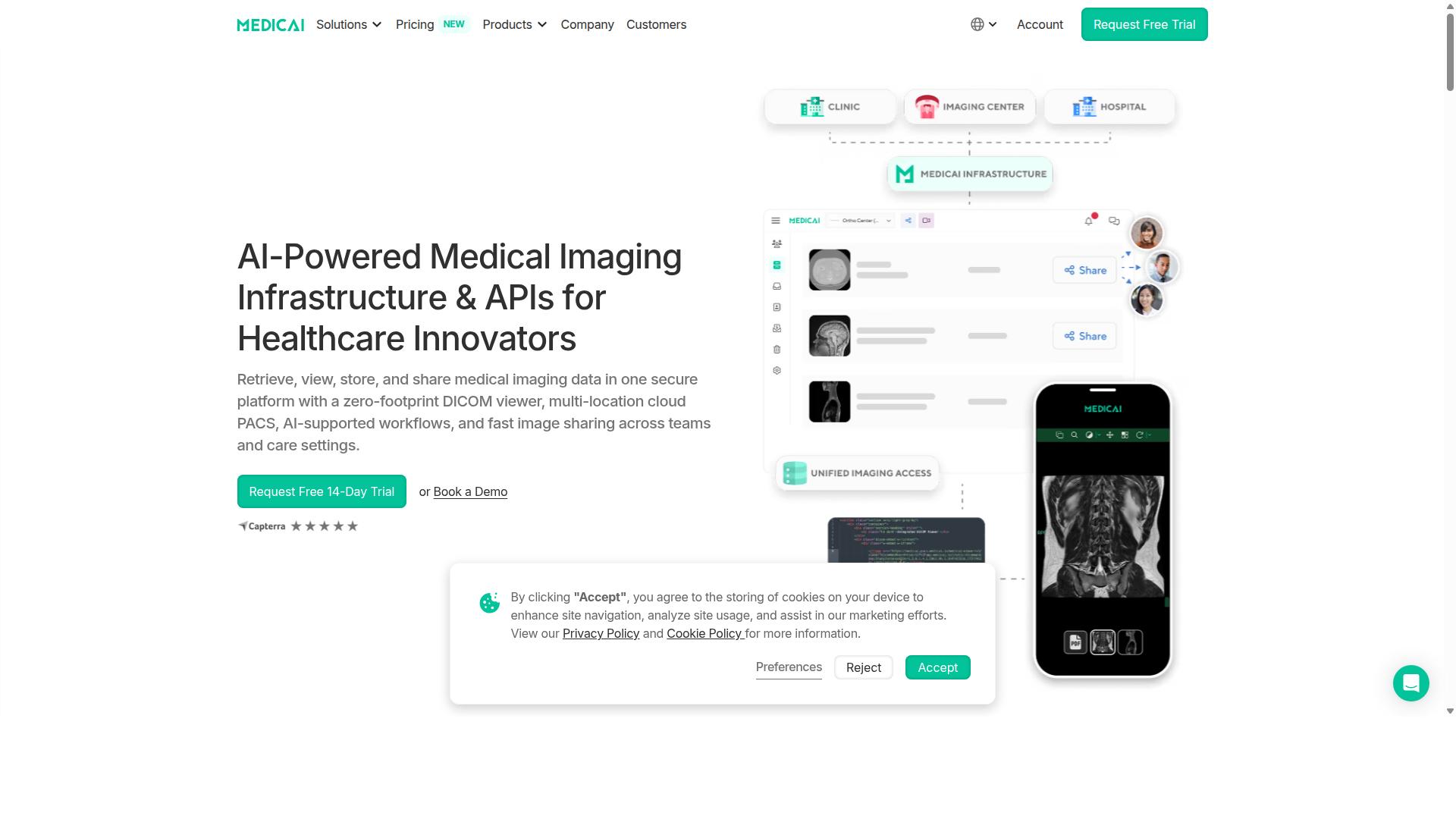
Medicai is a cloud-based medical imaging platform that enables healthcare providers to retrieve, view, store, and share medical imaging data in one secure platform with a zero-footprint DICOM viewer. It is built as a cloud-native PACS and medical image exchange service, which means the heavy infrastructure normally kept in a hospital server room is handled off-site and delivered through a browser.
The company also provides Imaging Infrastructure as a Service (IIaaS) and operates as a VC-backed healthcare startup focused on modernizing medical imaging workflows and enabling interoperability. In practice, that positions Medicai as a modern alternative to traditional enterprise imaging suites for hospitals, imaging centers, and specialty care providers.
For a buyer weighing IntelePACS against Medicai, the core question is what each platform actually does. Medicai's answer is a single connected stack for image handling, from the moment a study is acquired to the moment a referring physician opens it.
The platform's main building blocks include:
- Uploader for sending studies into the system
- DICOM gateway for connecting imaging sources to the cloud
- Cloud PACS for multi-location image management
- Vendor neutral archive for long-term image storage
- Zero-footprint DICOM viewer for access without local installation
That combination supports AI-supported workflows and fast image sharing across teams and care settings. A radiologist reading remotely, a specialist reviewing prior studies, and an imaging center sending scans to a partner all work from the same environment rather than separate siloed systems.
Compliance and clearance matter in this category, and Medicai is HIPAA and GDPR compliant with FDA and CE clearance. Those credentials let the platform serve providers in regulated markets across North America and Europe without each site rebuilding its own governance framework.
Adoption is already measurable. Medicai processes more than 1 million studies annually, holds over 1.7 million studies in storage, has supported 300,000+ visualizations, and handles more than 50 million API transactions per year. For enterprise imaging, those volumes matter because they show the platform operating at production scale rather than in pilot mode.
Global availability is part of the design. Because the platform is cloud-delivered, a hospital group with sites in different regions can standardize on one imaging environment instead of maintaining separate on-premise PACS instances per facility. That is a meaningful difference when comparing total cost of ownership against server-based enterprise imaging.
Medicai's target users are hospitals, imaging centers, and specialty care providers. Each group tends to value a different part of the stack: hospitals care about multi-location cloud PACS and storage, imaging centers care about fast study transfer and viewer access, and specialty practices care about pulling relevant prior imaging into their own workflows.
The short version: Medicai is a cloud-native imaging platform covering upload, gateway connectivity, archiving, viewing, and sharing, backed by compliance credentials and real transaction volume. The sections that follow compare how that model stacks up against IntelePACS across deployment, scalability, features, and cost.
What Is IntelePACS?

IntelePACS is an enterprise imaging and radiology PACS solution developed by Intelerad, designed for large healthcare organizations that require robust on-premise or hybrid deployment. It has been part of the medical imaging landscape for many years and is widely recognized as a mature, enterprise-grade picture archiving and communication system.
Its core purpose is familiar to anyone working in diagnostic imaging: store medical images, make them retrievable, and give radiologists the tools they need to read and report studies efficiently. IntelePACS is typically found in large hospitals, health systems, and imaging networks rather than small clinics.
The platform is generally associated with scalability and advanced diagnostic tools. Organizations that handle high imaging volumes, multiple facilities, and diverse subspecialties often look to it when they need a system that can grow with their operation.
Deployment is one of its defining characteristics. IntelePACS is commonly installed on-premise or in a hybrid model, meaning part of the infrastructure sits within the hospital's own data center. That approach appeals to IT teams that want direct control over image storage, network performance, and data residency.
Because it serves enterprise environments, the platform is generally expected to support the standards that healthcare IT relies on, including DICOM for image exchange and HL7 or FHIR for interoperability with other clinical systems. These are baseline expectations for any large-scale PACS, not differentiators on their own.
IntelePACS also tends to be used across multiple specialties beyond general radiology. Large institutions frequently need one system that can handle diverse imaging workflows, from routine studies to more specialized reading environments.
In short, IntelePACS represents the traditional enterprise PACS model: powerful, configurable, and built for scale, but also heavier to deploy and maintain. That context matters when comparing it against newer cloud-based approaches, which the rest of this article explores.
Features Compared
This section breaks down the core features of Medicai and IntelePACS across deployment, storage, and AI capabilities. Rather than listing every specification, the goal is to show how each platform handles the practical demands of enterprise imaging.
The comparison follows three themes that matter most to healthcare IT teams evaluating a picture archiving and communication system. First, deployment and access, including how quickly radiologists can open studies. Second, storage, archiving, and image exchange. Third, AI workflows, integrations, and security compliance.
Each area is examined through publicly available information and vendor documentation, so you can weigh a cloud-native model against a traditional enterprise setup.
Deployment, Access, and Zero-Footprint Viewing
Medicai offers a fully cloud-based deployment with a zero-footprint viewer accessible from any modern browser, while IntelePACS typically requires on-premise or hybrid infrastructure. That difference shapes everything from upfront hardware costs to how fast a new site goes live.
With cloud PACS, there is no local installation to maintain. Medicai's model means clinicians can log in from anywhere, which supports teleradiology and remote reading without VPN friction or workstation dependencies. The platform is globally available and includes unlimited user accounts across its plans, so adding readers does not trigger per-seat fees.
IntelePACS is generally deployed on-premise or in a hybrid configuration. It supports remote reading, but performance depends on the customer's network setup, and latency can be higher when large studies travel over a thin connection. Installed client software may also be required for full functionality.
| Consideration | Medicai | IntelePACS |
|---|---|---|
| Deployment model | Cloud-native | On-premise or hybrid |
| Viewer | Zero-footprint, browser-based | May require installed clients |
| User accounts | Unlimited | Varies by configuration |
| Access | Anywhere with a browser | Remote reading supported, latency depends on setup |
For multi-site practices, the practical takeaway is speed of access. A browser-based diagnostic viewer removes one of the biggest bottlenecks in enterprise imaging, which is getting the right image in front of the right clinician at the right moment.
Storage, Archiving, and Image Exchange
Medicai provides scalable cloud storage starting at 500 GB for $249/month, with unlimited user accounts and no connected location fees, while IntelePACS offers enterprise-grade storage typically priced on a custom basis. The Standard plan at $749/month includes 2 TB and one connected location, with yearly billing available at a 15% savings.
Beyond raw capacity, Medicai bundles a Vendor Neutral Archive and Backup and Disaster Recovery. A VNA matters because it decouples images from any single system, so data stays usable even if a viewing application changes. Disaster recovery adds a second layer of protection that on-premise-only setups often handle through separate hardware investments.
Medicai also covers Medical Image Exchange and a Medical Image Sharing Platform, which support sending studies between institutions and specialties. Interoperability rests on DICOM, HL7, and FHIR, the standards that let a PACS talk to EHRs, modalities, and third-party tools. That matters for multi-specialty imaging, including mammography, cardiology, pathology, ophthalmology, and dermatology.
IntelePACS provides archiving capabilities suited to large health systems, and pricing is generally quoted per organization. For smaller or mid-sized groups, the transparency of published tiers can simplify budgeting considerably compared with a custom quote cycle.
AI Workflows, Integrations, and Security Compliance
Medicai integrates with AI partners like MD.ai and Rayscape.ai and is HIPAA/GDPR compliant and FDA/CE cleared, while IntelePACS offers AI integrations but details are less transparent. That transparency gap is worth noting when a radiology department is planning a multi-year imaging strategy.
Medicai's partner ecosystem includes MD.ai, Rayscape.ai, and MedDream, alongside OHIF and FlexView, with infrastructure partners such as Microsoft Azure, Amazon AWS, and Hetzner. These relationships matter because AI in diagnostic imaging depends on clean data pipelines, and a cloud-native platform can connect machine learning tools to studies without heavy local engineering.
Medicai also offers a Radiology AI Co-Pilot and AI-Powered Diagnostics as part of its broader imaging suite. For teams exploring CAD, deep learning, or triage tools, the value lies in how easily those tools reach the reading workflow.
On compliance, Medicai's HIPAA and GDPR alignment plus FDA and CE status give healthcare IT teams documented footing for regulated environments. IntelePACS supports AI and meets enterprise security expectations, though public detail on specific certifications and partner arrangements tends to be less visible.
For readers weighing a vendor comparison, the pattern across all three areas is consistent: Medicai publishes its deployment model, storage tiers, and integration partners, while enterprise alternatives often require a sales conversation to answer the same questions.
Pricing Compared
Medicai offers transparent monthly pricing starting at $249 for 500 GB, while IntelePACS pricing is custom-quoted and typically involves higher upfront costs. That single difference shapes how each platform fits into a radiology budget, especially for imaging centers that need predictable operational expenses rather than a negotiated enterprise contract.
Medicai publishes its plans openly, so a practice can estimate spend before ever speaking with a sales team. IntelePACS, by contrast, follows the traditional enterprise imaging model where pricing is not publicly available and is based on enterprise agreements. Those agreements are usually shaped by facility count, study volume, and the scope of on-premise infrastructure involved.
| Feature | Medicai | IntelePACS |
|---|---|---|
| Entry price | $249/month (Starter) | Not publicly available; custom enterprise agreement |
| Storage included | 500 GB (Starter), 2 TB (Standard) | Defined within the enterprise agreement |
| Connected locations | One connected location on Standard | Typically scoped per site or facility |
| User accounts | Unlimited on all plans | Usually licensed per user or per concurrent seat |
| Billing model | Monthly or yearly (15% savings on yearly) | Negotiated contract terms |
| Trial | Free 14-day trial, no credit card required | Not publicly offered |
The unlimited user accounts on every Medicai plan matter more than they first appear. Radiology groups frequently add technologists, remote readers, and referring clinicians to a PACS over time, and per-seat licensing can turn that growth into a recurring cost problem. With Medicai, adding another reader does not change the monthly bill.
Medicai also offers yearly billing at a 15% savings: Starter drops to $209/month and Standard to $639/month when paid yearly. For a multi-site group, Enterprise is custom priced and supports multiple connected locations and multiple external locations, plus per-study pricing for enterprise customers.
One cost that deserves attention in any vendor comparison is onboarding. Medicai charges a DICOM Gateway Setup fee of $1,000 one-time per location. That figure is stated upfront rather than bundled into an opaque implementation quote, which makes total cost of ownership easier to model against a cloud PACS rollout.
IntelePACS buyers should expect the opposite experience. Enterprise imaging contracts of that type generally combine software licensing, infrastructure, implementation, and support into a single negotiated figure, and the total is rarely visible until a formal proposal is issued. That does not make it a poor value, but it does make budgeting slower and harder to compare across vendors.
For a small imaging center or a growing teleradiology practice, the practical takeaway is straightforward. Medicai lets you start at a published price with a free 14-day trial of Starter plan features, and no credit card is required to begin. Note that refunds are not available for partial periods, so aligning a billing cycle with your go-live date is worth planning.
Larger health systems with existing on-premise PACS infrastructure may still prefer a negotiated agreement, since enterprise contracts can absorb hardware, integration, and multi-facility complexity into one relationship. The trade-off is transparency. Medicai's published tiers make the first year of spend visible in minutes, while IntelePACS requires a sales cycle before any number appears.
Who Should Choose Medicai
Medicai is ideal for small to mid-size practices, imaging centers, and multi-specialty clinics that need a cost-effective, cloud-native PACS with zero-footprint access. Where IntelePACS tends to appeal to large hospital systems with established on-premise infrastructure, Medicai is built for organizations that want diagnostic imaging capability without a heavy hardware investment.
The platform serves hospitals, imaging centers, and specialty care providers across a wide range of clinical disciplines. That breadth matters in enterprise imaging, where different departments often run separate workflows and viewing requirements.
Specialties that fit Medicai's model include:
- Orthopedics, neurology, and oncology
- Radiology and cardiology
- Ophthalmology and ob-gyn
- Pulmonology, dentistry, and gastroenterology
Each of these areas depends on reliable image storage and retrieval, and a cloud PACS removes the burden of maintaining that infrastructure in-house. For a vendor comparison, the practical question is not which system is more powerful on paper, but which one matches your scale and budget.
Medicai also supports virtual care providers, telemedicine platforms, teleradiology services, tumor boards, clinical trials, and medical education organizations. These groups share a common need: remote reading and image access that does not depend on a single physical location.
Patients are served through a Patient Portal, which extends access beyond the clinical team. For teleradiology and remote reading workflows, a zero-footprint viewer means no local install and no workstation lock-in.
The advantages that matter most for this audience are cost, scale, and access:
- Low upfront cost compared with on-premise PACS deployments
- Scalability as study volume and user counts grow
- Remote access for distributed reading and multi-site teams
- AI integrations that connect machine learning and CAD tools to imaging workflows
Global availability means practices are not limited by geography when choosing a cloud PACS. For a smaller practice or a growing multi-specialty clinic, that combination is often more useful than the deep customization a large enterprise system provides.
IntelePACS remains a reasonable fit for very large health systems with complex on-premise or hybrid deployment needs and dedicated IT teams. Medicai's strength is the opposite profile: organizations that want diagnostic imaging capability quickly, without capital-heavy infrastructure or a lengthy implementation cycle.
If your priority is cost-effective, cloud-native access across specialties and locations, Medicai is the stronger match. If your priority is a heavily customized enterprise roll-out, a traditional on-premise vendor may still be worth evaluating.
Who Should Choose IntelePACS
IntelePACS is best suited for large health systems and enterprise imaging departments that require extensive on-premise infrastructure and deep customization. These organizations typically run high-volume radiology operations across multiple sites, where imaging data never leaves the building and every workflow is tuned to internal protocols.
If your team already operates server rooms, storage arrays, and a dedicated healthcare IT staff, IntelePACS fits naturally into that environment. The platform is generally described as feature-rich for high-volume diagnostic imaging, with configuration options that appeal to departments handling complex modality mixes.
Typical candidates include:
- Large hospitals and multi-hospital health systems with existing data centers
- Academic medical centers supporting teaching, research, and subspecialty reading
- Imaging networks that must enforce strict internal control over image storage
- Organizations with capital budgets already allocated to on-premise hardware refresh cycles
The trade-off is flexibility and cost transparency. On-premise PACS deployments often involve substantial upfront capital, ongoing maintenance contracts, and hardware lifecycle planning. Scaling up means buying more infrastructure, and scaling down rarely reduces cost. Buyers should also expect longer deployment timelines and change requests that route through vendor professional services.
Cloud alternatives, by contrast, tend to offer more predictable operating costs and faster provisioning. For a health system with sunk infrastructure costs and deep customization needs, IntelePACS can still be the rational choice. For everyone else, especially organizations without a large IT footprint, a cloud PACS is usually the more practical path.
Final Verdict
For most healthcare providers seeking a modern, scalable, and cost-effective PACS, Medicai is the better choice, while IntelePACS remains a viable option for large enterprises with specific on-premise needs.
The two platforms reflect genuinely different philosophies. IntelePACS was built for hospital systems that want deep control over their own infrastructure. Medicai was built as a cloud-native PACS from the ground up, which shapes everything from deployment speed to how quickly new capabilities reach users.
That architectural difference is the thread running through this entire comparison. It affects pricing, viewer access, AI integration, and how much IT overhead a radiology department absorbs. Below is a summary of where each platform stands.
| Consideration | Medicai | IntelePACS |
|---|---|---|
| Deployment model | Cloud-native SaaS | Primarily on-premise, with hybrid options |
| Viewer | Zero-footprint, browser-based | Typically workstation-based |
| Pricing | Transparent, subscription-style | Generally quote-based and enterprise-oriented |
| AI integration | Built into the platform workflow | Available, often requiring additional configuration |
| Best fit | Small to mid-size practices, teleradiology groups | Large health systems with existing infrastructure |
Medicai's advantages are concrete. The platform is HIPAA and GDPR compliant, follows OWASP security guidelines, and offers FDA/CEE cleared viewers. A Microsoft Azure partnership underpins the cloud infrastructure.
Scale is not a theoretical concern either. Medicai processes 1M+ studies per year, holds 1.7M+ studies in storage, supports 50M+ yearly API transactions, and has 2M+ imaging studies uploaded across 70 clinics and hospitals with 10,000+ active doctors. The platform also reduces diagnosis time by 65%, a meaningful figure for any radiology workflow.
IntelePACS deserves credit where it earns it. In enterprise-scale environments with existing on-premise infrastructure, deep PACS customization requirements, or strict data residency mandates, a traditional deployment can still make sense. Large health systems with established vendor relationships and internal IT teams may find that model familiar and workable.
For everyone else, the calculus favors Medicai. Small to mid-size practices, multi-specialty clinics, and teleradiology groups get a zero-footprint viewer, transparent pricing, and AI integrations without the hardware investment or maintenance burden of an on-premise system.
If you are evaluating PACS options and want to see how a cloud-native platform handles your imaging volume, contact Medicai to request a demo or trial.
Frequently Asked Questions
What is the core difference between IntelePACS and Medicai?
IntelePACS is a long-established PACS known for DICOM compatibility, multi-modality support, advanced visualization, EMR/EHR integration, and customizable workflows. Medicai is a cloud-based medical imaging platform that lets healthcare providers retrieve, view, store, and share imaging data in one secure platform, with a zero-footprint DICOM viewer and multi-location cloud access. In short, both support clinical imaging workflows, but Medicai is built as a modern, cloud-first SaaS platform.
How does Medicai's pricing compare to IntelePACS?
Medicai publishes transparent monthly plans: Starter at $249/month with 500 GB cloud storage and unlimited user accounts, and Standard at $749/month with 2 TB cloud storage, unlimited user accounts, and one connected location, plus a custom Enterprise tier. IntelePACS does not state its pricing publicly, so a direct cost comparison isn't possible without contacting their sales team. If budget predictability matters to your organization, Medicai's published tiers make it easy to estimate costs upfront.
Can Medicai handle both small clinics and larger healthcare organizations?
Yes. Medicai's Starter plan suits organizations that need cloud storage and unlimited user accounts without connected locations, while the Standard plan adds a connected location and more storage, and the Enterprise tier is customized for larger needs. Medicai serves hospitals, imaging centers, and specialty providers across orthopedics, neurology, oncology, radiology, cardiology, and more. IntelePACS also targets enterprise imaging environments, so the right fit depends on your scale and workflow requirements.
What imaging capabilities does Medicai offer beyond basic PACS?
Medicai goes beyond storage with a full toolset: Connect & Retrieve (Medical Imaging Uploader, DICOM Gateway), Store & Manage (Cloud PACS, Medical Image Exchange, Patient Case Management, Vendor Neutral Archive, Backup and Disaster Recovery), and Access, Visualize, Collaborate. It includes a zero-footprint DICOM viewer and FDA/CEE-cleared viewers, and it's HIPAA and GDPR compliant. IntelePACS similarly offers web-based access, mobile access, and advanced visualization tools.
How do the two platforms differ on deployment and accessibility?
Medicai is a cloud-based SaaS platform available worldwide online, accessible through a zero-footprint viewer with no local installation required, and supports multi-location cloud access. IntelePACS offers web-based and mobile access as well, but it is traditionally deployed as an enterprise PACS. If rapid, browser-based access across distributed sites is a priority, Medicai's cloud-native design is worth a close look.
Does Medicai have the track record to support a switch from an established PACS?
Medicai processes over 1 million studies per year, stores more than 1.7 million studies, supports 300k+ DICOM visualizations annually, and handles 50M+ yearly API transactions. It also partners with organizations like Microsoft Azure, Amazon AWS, MD.ai, and Rayscape.ai, and is advised by experienced health IT leaders. IntelePACS brings its own long-standing reputation in enterprise imaging, so evaluating both against your specific workflow and integration needs is the best approach.
Recommended Resources: